
Euro Stacking Containers Explained: Applications, Sizes and What to Look for When Buying
Euro stacking containers are one of the most practical and widely used storage and handling solutions in industrial, manufacturing and logistics environments. Straightforward in concept, highly versatile in application, and available in a range of configurations that suit everything from food production to automotive assembly, they are a staple of efficient material handling.
This guide covers what euro stacking containers are, where and how they are used, the different types available, and what to look for when choosing a supplier.
What are Euro Stacking Containers?
Euro stacking containers are rigid plastic boxes designed to stack stably on top of one another, optimising vertical storage space without the need for additional racking infrastructure. They take their name from the euro pallet footprint system: the most common sizes are based on subdivisions of the 1200x800mm euro pallet, meaning containers in standard euro dimensions can be packed onto pallets efficiently with no wasted space.
The containers are typically manufactured from high-density polyethylene or polypropylene, giving them the combination of rigidity, impact resistance and chemical resistance required for demanding industrial environments. Straight internal walls maximise usable volume relative to external dimensions, and reinforced corners provide the structural integrity needed when containers are stacked under load or handled by forklift or automated equipment.
Where are Euro Stacking Containers Used?
The range of applications is broad. Euro stacking containers are used wherever goods, components or materials need to be stored, transported or presented systematically and efficiently.
- In manufacturing and automotive environments, they are used to move components between workstations, store parts in line-side kitting systems, and transport finished goods through assembly and despatch. The ability to stack containers in stable columns reduces floor space requirements and simplifies inventory management.
- In food production and processing, perforated variants allow air circulation around produce, while solid-walled containers provide containment for liquids or fine materials. Food-grade material options ensure compliance with hygiene requirements.
- In logistics and distribution, euro stacking containers function as returnable packaging solutions, cycling between supplier and customer and reducing the cost and waste associated with single-use packaging. Their compatibility with conveyor systems, thanks to smooth bases that allow quiet and consistent movement, makes them well-suited to automated handling environments.
- In retail and e-commerce fulfilment, they are used for order picking, goods-in processing and the movement of stock between storage and despatch areas.
Types of Euro Stacking Container
Not all euro stacking containers are the same. The range of types available reflects the breadth of applications they serve.
- Solid containers have fully enclosed walls and bases, providing containment for small components, powders or liquids. They are the most common general-purpose option.
- Perforated containers feature ventilated walls and bases, suited to applications where airflow around contents is required. Common in food production and agricultural storage.
- KLT containers conform to the VDA KLT standard used widely in the automotive industry. They are designed for use in just-in-time manufacturing environments and are compatible with automated handling systems used across automotive supply chains.
- ESD containers are manufactured from electrostatic dissipative materials, protecting sensitive electronic components from static damage during storage and transit.
- Hinged lid containers incorporate an attached lid that folds back for access and closes securely for transit or storage. These are particularly useful where contents need protection from dust or contamination without requiring a separate lid to be managed.
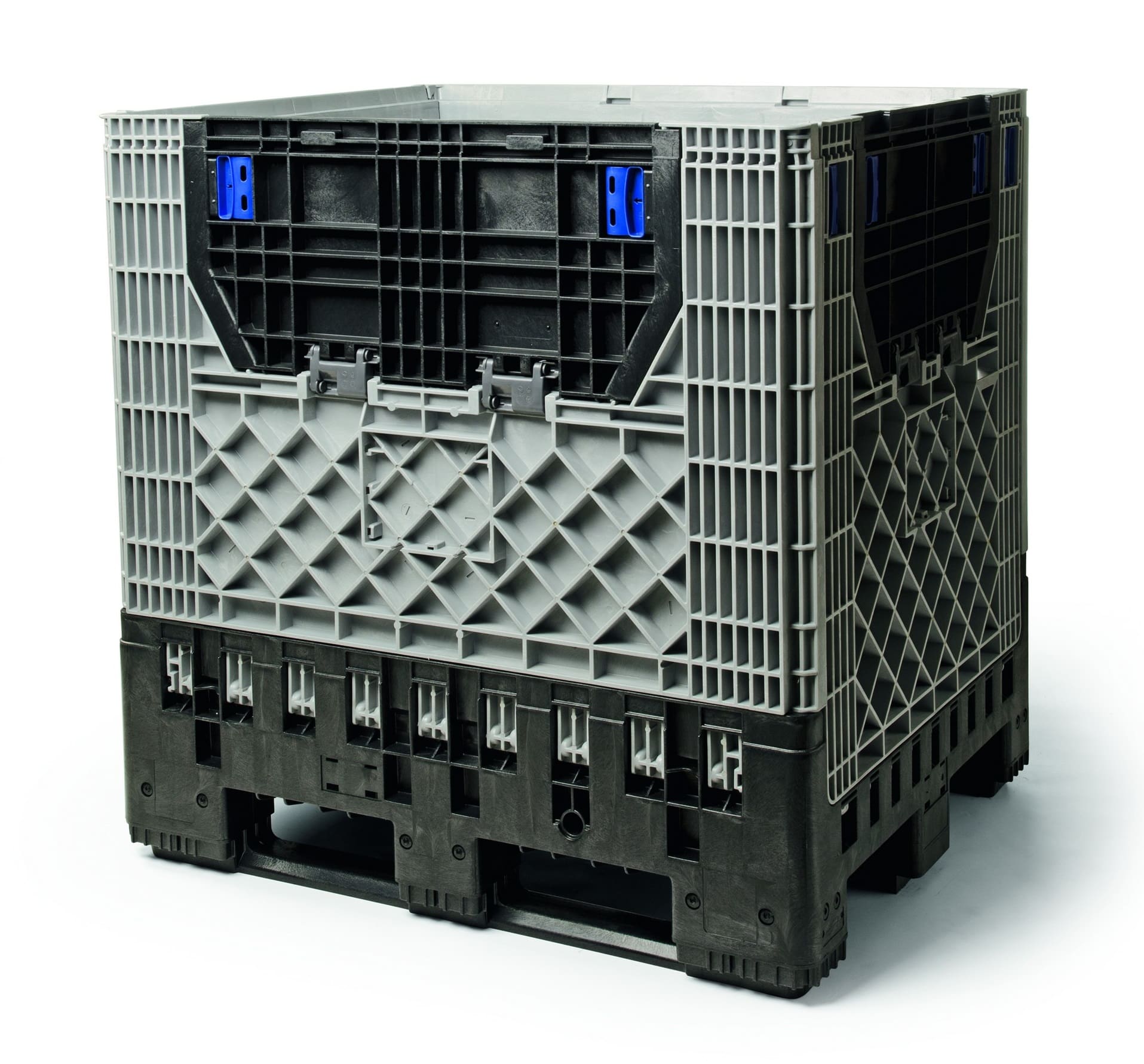
- Folding containers collapse when empty, significantly reducing the volume they occupy during return journeys or when stored out of use. These are a practical choice for operations where the ratio of full to empty containers in circulation creates a storage challenge.
- Coloured containers allow colour-coded organisation of components, stock or workflows, supporting visual management systems in manufacturing and logistics environments.
Reconditioned containers offer a cost-effective option where budget is a priority and the performance requirements of the application do not demand new stock.
Euro Stacking Container Sizes
Standard euro stacking containers follow the modular euro footprint system, with common external dimensions including 200x150mm, 300x200mm, 400x300mm, 600x400mm, 800x400mm, 800x600mm and larger. Heights vary to suit different volume requirements, with container volumes ranging from compact options of less than 25 litres up to larger formats exceeding 170 litres.
The modular sizing system matters in practice because it ensures compatibility across your handling infrastructure. Containers that conform to euro dimensions will stack consistently with one another, fit standard pallet footprints without overhang, and interface predictably with conveyor and racking systems designed around the same standard.
If a standard size does not meet your requirements, a manufacturer with in-house production capability can accommodate non-standard dimensions. This is particularly relevant for applications where components or products have specific spatial requirements that standard containers do not address efficiently.
What To Look for When Choosing a Supplier
The range of euro stacking containers on the market is wide, and the differences between suppliers are not always immediately obvious. A few considerations are worth keeping in mind.
- In-house manufacture is a meaningful distinction. A supplier that produces containers at their own facility has direct control over material quality, dimensional consistency and production standards. They can also accommodate bespoke requirements and non-standard sizes without relying on third-party tooling or manufacturing capacity.
- Range breadth matters for operational simplicity. Being able to source solid, perforated, KLT, ESD, hinged lid and folding variants from a single supplier reduces procurement complexity and ensures compatibility across your container estate.
- Colour availability is relevant if you operate visual management or colour-coded kitting systems. A supplier offering a full colour range gives you flexibility to implement or extend these systems without switching suppliers as your needs evolve.
- Load and stack ratings should be checked against your specific application. Containers that will be handled by forklift or automated equipment, or stacked at significant height, need reinforced corners and bases rated for the loads involved.
- Availability and lead times are particularly important for high-volume or time-sensitive operations. A supplier with stock held in depth and the ability to manufacture against demand provides supply continuity that catalogue-only distributors cannot always match.
Euro Stacking Containers from PMN
Plastic Mouldings Northern manufactures and supplies euro stacking containers from our 65,000 sq ft facility in Bishop Auckland. Our range covers solid, perforated, KLT, ESD, hinged lid, folding, coloured and reconditioned variants across a full spread of euro footprint sizes, with volumes from under 25 litres to over 170 litres and a full range of colour options including blue, green, grey, orange, red, yellow and more.
Where standard sizes do not meet your requirements, we can discuss bespoke options. If you are looking to source euro stacking containers in volume, or if you need a supplier who can accommodate specific size, material or configuration requirements, we would be glad to help. View the full euro stacking containers range or get in touch with the PMN team.